

If you have opened an account at a licensed gaming operator in the last few years, you have met KYC, usually at the moment you tried to make your first withdrawal. The checks feel like paperwork. They are the visible end of a system built on two ideas. The operator must know who you are before you gamble, and it must keep watching after you start. This article explains what those checks actually look at, why they are tiered, and what triggers a request for payslips or bank statements.
Verification is a regulatory condition for holding a licence. The rules come from a global standard-setter, the Financial Action Task Force (FATF), filtered through national regulators. Understanding the mechanism makes the process faster and less surprising.
What KYC actually checks (and why it happens before you gamble)
Know Your Customer, or KYC, is the identity part of a wider anti-money-laundering (AML) obligation. The operator must verify who you are using documents or data from a reliable, independent source. That is the wording of FATF Recommendation 10, which applies to gambling operators as it does to banks.
A “reliable, independent source” is usually a passport or national ID card issued by a government, a utility bill or bank statement sent to your address, and sometimes a selfie or live photo matched against the document. The operator is not collecting this for its own curiosity. It needs to confirm three things. You are who you say you are, you are old enough to gamble legally, and the name on your payment method matches the name on your account.
The timing matters more than most players realise. In Great Britain, for example, the Gambling Commission requires operators to verify a customer’s identity, including name, address, and date of birth, before that customer is allowed to gamble at all. That is a stricter standard than in many other markets, where verification can be deferred until the first cash-out. The British approach exists because a gambling debt incurred by a fraudster or a minor creates harm that a later withdrawal block cannot undo. Verification before play is a consumer-protection measure as much as an AML one.
You register, deposit £50, and play for an hour. If the operator is under the British rule, it must have verified your identity before you placed the first bet. If you registered yesterday and the check is still pending, you may find your play restricted or your deposit returned until the check completes. That is the licence talking.
The three tiers: Simplified, Customer, and Enhanced Due Diligence
Not every player gets the same level of scrutiny. FATF and national regulators expect a risk-based approach. The more risk an account presents, the deeper the check. The industry has settled on three tiers.
| Tier | When it applies | What it checks |
|---|---|---|
| SDD (Simplified Due Diligence) | Low-risk accounts, low deposit limits, verified payment method | Basic identity (name, date of birth), sometimes address only |
| CDD (Customer Due Diligence) | The default tier for most players | Full identity documents, address proof, payment-method ownership |
| EDD (Enhanced Due Diligence) | High deposits, unusual patterns, PEPs, rapid spending | Source of funds (payslips, bank statements, tax documents), sometimes source of wealth |
Simplified Due Diligence is rare in practice at real-money gambling sites. It is designed for situations where the risk of money laundering is low, such as small stakes, a single verified payment method, and no anonymity. Most operators skip it and go straight to standard CDD because the cost of a full check has fallen to near zero with automated document verification.
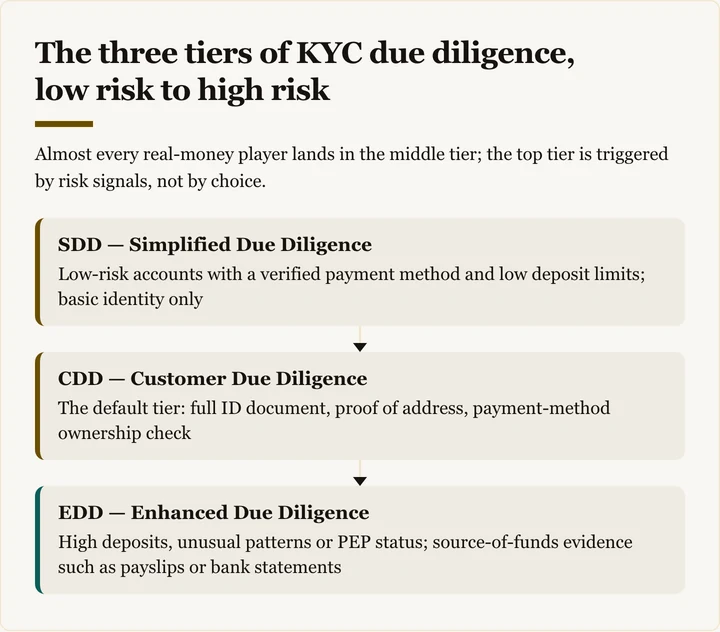
Standard Customer Due Diligence is the tier you will meet. It means the operator collects your full name, date of birth, and address, then verifies them against an ID document and a proof of address. The document check is usually automated. You photograph your passport, the software reads the machine-readable zone, checks the hologram patterns, and compares your face to the photo. The address check often uses a utility bill or a bank statement dated within the last three months.
Enhanced Due Diligence is the tier nobody wants to meet, and it is also the one that causes the most confusion. It is triggered by risk signals, and those triggers are concrete. A single deposit far above your normal pattern qualifies, as does a series of transactions that look structured to stay under a reporting threshold, or signs of rapid, heavy spending that do not match what the operator knows about you. Politically exposed persons, meaning people holding significant public office, are also routed into EDD as a matter of policy, because their position creates a higher risk of corruption-related money flows.
Why an account gets flagged for source-of-funds evidence
The single most common player complaint is the source-of-funds request. The operator asks for payslips, bank statements, or tax documents, and the player feels accused of something. The request is a standard compliance procedure that applies to any customer whose transaction pattern meets defined risk criteria.
Source-of-funds evidence is a product of Enhanced Due Diligence. The operator has already verified who you are. What it cannot see is where your money came from. A bank transfer shows the operator that funds arrived from your bank, but it does not show whether those funds were salary, savings, a loan, or proceeds of something illegal. When the risk signals are strong enough, the operator is legally required to ask.
The trigger is usually a combination of factors. A £10,000 deposit from a player who has been active for a week, with no previous history of deposits above £500, will almost certainly trigger a request. So will a pattern of deposits just under a threshold, such as £2,900 repeated several times when the reporting limit is £3,000. That pattern is called structuring, and it is itself a red flag that AML systems are trained to catch.
If you are flagged, the operator will ask for documents that show the origin of the specific funds. A payslip covering the deposit period, a bank statement showing the salary credit and the subsequent transfer to the operator, or a tax document if the funds came from self-employment all qualify. The request is not an accusation. It is the operator demonstrating to its regulator that it applied due diligence before accepting a high-risk transaction. Refusing to provide the documents will usually result in the account being restricted or closed, because the operator cannot legally continue the relationship without the information.
The request is about the funds themselves. Providing a document that shows you won the money elsewhere does not satisfy the request, because the operator needs to see the original source, whether salary, savings, or sale of an asset. That is why the standard ask is a payslip or bank statement, not a screenshot of your casino balance.
What ongoing transaction monitoring looks for after onboarding
Verification is not a one-time event. Once you are onboarded, the operator’s AML system watches your transactions continuously. The monitoring is automated, rule-based, and designed to flag behaviour that looks like money laundering.
The classic patterns are well documented. Large or unusual deposits relative to your history are flagged. Minimal gambling relative to deposits is a major signal. If you deposit £5,000 and play £200 before requesting a withdrawal, the operator will ask why the money came in at all. Structuring deposits to dodge thresholds is another flag. Fast withdrawal after little play, such as depositing and cashing out within hours without meaningful wagering, looks like a funds pass-through. Multiple accounts or multiple payment methods under the same identity are also flagged, because they are common tools for spreading transactions across reporting limits.

The monitoring is not looking for winning or losing. A player who deposits £1,000, plays for six hours, and loses the lot is a normal customer. A player who deposits £1,000, plays three spins, and withdraws £980 is a red flag. The difference lies in the gambling behaviour relative to the money movement.
Being flagged by the system usually produces nothing visible at first. The flag goes to a compliance officer, who reviews the pattern. If the review finds nothing suspicious, such as a £5,000 deposit because you sold a car and wanted to play with the proceeds, the flag is closed. If the pattern is not explained by the account history, the operator may freeze the withdrawal and ask for source-of-funds evidence, which brings you back to the previous section.
Where the rules come from: FATF, national regulators, and the licence
The chain of authority runs from a global body down to the individual licence. At the top is the Financial Action Task Force, an intergovernmental organisation that sets international standards for combating money laundering and terrorist financing. Its Recommendations are enforced indirectly through country evaluations and listing mechanisms. Countries that do not implement them are placed on grey lists that make international banking harder.
FATF’s guidance to the gambling sector is specific. Recommendation 10 requires customer due diligence using reliable, independent source documents. The accompanying guidance for casinos calls for due diligence above defined transaction thresholds, with the commonly cited figure around USD/EUR 3,000, and enhanced measures for high-risk customers, including politically exposed persons. The FATF guidance document, first issued in 2013 and updated in 2017, walks through how these measures apply to casino operations, including online gambling.
Below FATF sit national regulators. The UK Gambling Commission, the Malta Gaming Authority, the Swedish Spelinspektionen, and others each translate the FATF Recommendations into binding licence conditions. The British rule that identity must be verified before gambling is an example of a national regulator going further than the FATF minimum. The licence itself is the enforcement mechanism. An operator that fails its AML obligations risks fines, suspension, or loss of the licence entirely.
For the player, verification requirements are the price of a licence, and the licence is what makes the operator accountable. This is part of the broader regulatory compliance framework that governs how licensed operators handle everything from player funds to dispute resolution. The same framework that requires KYC also requires fair-play testing of the games themselves. Both are conditions of the licence.
What a player can do to keep verification fast and honest
The verification process is faster when you treat it as a standard part of opening an account. A few practical habits make the difference between a ten-minute check and a three-day delay.
Registering with your legal name and current address is the first habit to adopt. A mismatch between your registration details and your ID document is the most common cause of a failed check. If you have moved recently, update your address with your bank before you register with the operator, so the bank statement you provide matches your registration.
Documents ready before you need them save the most time. A passport or national ID for identity, and a recent utility bill or bank statement for address. Photograph them in good light, with all four corners visible and no glare. Automated document checks fail more often on image quality than on the document itself.
Large deposits planned in advance deserve a proactive approach. If you are planning a deposit that is significantly larger than your usual pattern, contact the operator’s support team in advance and ask whether source-of-funds evidence will be required. Some operators will accept a payslip or bank statement before the deposit, which avoids a withdrawal freeze later.
Consistent gambling behaviour keeps the monitoring systems quiet. If you deposit to play, play. If you deposit and immediately withdraw, expect questions. The monitoring systems are looking for exactly that pattern, and a withdrawal freeze is the predictable result.
Verification delays are a normal compliance step, not a personal judgment. The operator is checking the origin of the money. Depositing additional funds to demonstrate that you have money will not satisfy a source-of-funds request. It will extend the review, because now the operator has to account for the new deposit too. If you are gambling with money you cannot afford to lose, that is a separate problem that no verification process will solve. Responsible gambling resources are available through the operator’s own tools and through national helplines.
18+. Gambling can be addictive. Play within your means, and use the operator’s or a national helpline’s tools if it stops feeling optional.
FAQ
Does KYC apply to every deposit, or only withdrawals? In most licensed markets, identity verification is required before you can gamble, not only before you withdraw. The UK Gambling Commission enforces this strictly. In other jurisdictions, the check may be deferred to the first withdrawal, but the operator is still required to complete it eventually.
What documents count as proof of source of funds? Payslips, bank statements showing salary credits, and tax documents are the standard accepted forms. The document must show the origin of the specific funds you deposited. A screenshot of your casino balance does not count, because it does not show where the money came from.
How long does a source-of-funds review take? Most reviews are completed within days rather than weeks, but the exact timing depends on the operator’s compliance team and whether the submitted documents are clear. If the documents are incomplete or the pattern is complex, the review can take longer. The operator is required to complete the review before releasing the withdrawal.
Can I refuse to provide source-of-funds documents? You can, but the operator is legally required to complete due diligence before continuing the relationship. Refusal will usually result in the account being restricted or closed, and the withdrawal being returned to the original payment method. The operator is complying with its licence conditions.
Is my personal data safe with the operator’s compliance team? Licensed operators are required to store KYC and AML data securely and to use it only for compliance purposes. The data is subject to data-protection law in the operator’s jurisdiction, and it is shared with regulators or law enforcement only when legally required. This data handling falls under the same regulatory compliance framework that sets the standards for licensed operators’ conduct.